Backstage Blog

Introducing the Large Hadron Migrator
Rails style database migrations are a useful way to evolve your data schema in an agile manner. Most Rails projects start like this, and at first, making changes is fast and easy.
That is until your tables grow to millions of records. At this point, the locking nature of ALTER TABLE may take your site down for an hour our more while critical tables are migrated. In order to avoid this, developers begin to design around the problem by introducing join tables or moving the data into another layer…
Marbleo.us
Greetings! I’m Robb and this is my first SoundCloud Backstage blog post. During the day I’m a developer working on the Mac App here in the SoundCloud office, but I’m also a university student. It was through Uni that I found out about and entered the annual informatiCup competition with my friend Simon.

Although we didn’t make it into the final around, I consider the project we made – a web-based marble run simulator called Marbleo.us – to be a success. Here’s a fun example map to try it out.
…
Web Scale Statistics – Failing with MongoDB
As SoundCloud rapidly grows our initial systems need an overhaul. Our scaling strategy has been very realistic, design for 10x our current usage. Our initial statistics system found under https://soundcloud.com/you/stats was made when we were 100k users, living long past its expiration date.
Background
About a year ago we started off with the goal of redesigning the statistics pages to support 500 playbacks a second. We knew that this would be a write-heavy workload and that to sustain bursts of writes, we’d need decent partitioning. Coming from a successful experience moving the Dashboard feature to Cassandra 0.6…
Stream and Download
April 6th, 2011 by Henrik LenbergUPDATE: Check out our guide on Playing Sounds for the most up to date information.
This is an introduction to how you can power your app or website with sounds hosted on SoundCloud. Via our API, you get access to millions of different sounds, and in addition to streaming and downloading tracks, you can access meta data and social features like comments and followings.
Custom Players
April 6th, 2011 by Henrik LenbergUPDATE: Check out our guide on Playing Sounds for the most up to date information.
We think the default audio widget from SoundCloud already is one of the sexiest on the web. But maybe you need something a bit simpler or complex and want to tailor the player to your needs. This is where the idea of “custom players” comes into play.
Sharing Sounds
April 5th, 2011 by Henrik LenbergUPDATE: Check out our guides on Authentication and Sharing Sounds for the most recent information.
If you build an app or web service that generates any type of sound, it’s easy to connect it to SoundCloud and enable your users to share their creations across the web. Allowing users to share what they create to their existing social networks and the SoundCloud community brings great value in a variety of use cases. If you have an app for beat making, you can let your users post their creations to a dedicated group on SoundCloud. For aspiring music makers, it’s valuable and fun to get feedback from friends on Facebook. And for someone recording an interview with their phone, it’s super handy to be able to post the audio directly to a blog. In addition, a sharing feature is obviously practical for sending files to collaborators or moving audio between devices.
Hello developers!
April 4th, 2011 by Johannes WagenerWe are happy to introduce you to our new developer portal developers.soundcloud.com. Here we are bundling up all the SoundCloud platform and developer related products and resources. It will give you the best starting point to dig into our API and all things related! Let us know what you think about it!
Experiment 01: Puzzle To Unlock
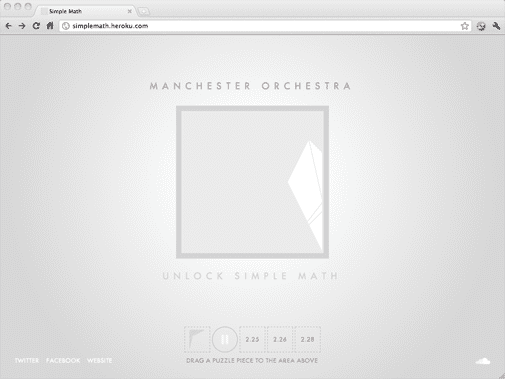
This “Puzzle to Unlock” concept came to me straight from Manchester Orchestra’s wonderful label/management team, and we were able to pull it together very quickly with SoundCloud, jQuery, and SoundManager2.
The band wanted to build a bit of excitement around the premiere of their new single “Simple Math.” So we developed a way to tease the song with dialogue from the artist and actual clips of audio released as “pieces” to a puzzle that will unlock both the album cover and track. Cool, right?
…
We ♥ OAuth 2
January 19th, 2011 by Johan

From today on, we advise developers to use OAuth 2 as preferred way of API authentication. Our implementation of the Draft 10 OAuth 2 specification is in production for several months months now and we made good experiences with it. Thus we move it from beta to official recommendation.
OAuth 2 makes it easier for developers to implement authentication for accessing private resources. The feedback we got from external app developers and our in-house API users has been very positive. This is what Ullrich, one of the developers of the SoundCloud iPhone app and Cocoa wrapper, has to say about…
iOS Sharing Guide
January 1st, 2011 by Gernot PoetschSo you are familiar with the SoundCloud API Wrapper and want to use it to share the sounds you upload? And you want to use the existing connections on SoundCloud or make new ones? Awesome. Here’s how to do it.