Backstage Blog

Desktop Sharing Kits for OS X and Windows
April 10th, 2012 by Amir ShaikhLast week we announced a new integration with Ableton Live 8, that lets you easily share your sounds from within Ableton Live to SoundCloud. Today we’re making the technology behind that integration available to everyone through our new Desktop Sharing Kits.

Wave Raid powered by Timed Comments
April 5th, 2012 by Lee Martin
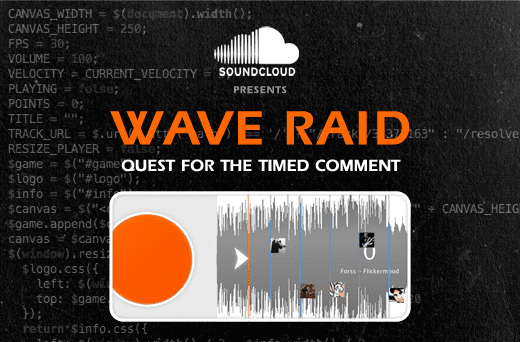
One of the SoundCloud API’s most powerful features is the timed comment. At its core it seems simple enough: a piece of text associated with a point in time for a particular track. But where you see timed opinions, I see a light-weight game scripting engine.
So when Johannes Wagener told me he was adding an ontimedcomments event to our JS SDK, I immediately began work on Wave Raid: Quest for the Timed Comment.
Developer Contest: SoundCloud + Acapela Group Mashup
April 4th, 2012 by Paul OsmanSoundCloud is teaming up with Acapela Group for our first Developer Contest. Acapela Group offers amazing text to speech solutions and have a variety of SDKs so you can write apps that create sound files using one of their voices (including hip-hop and country!). Take a listen to some sample voices.
We’re calling on our developer community to mashup SoundCloud and Acapela. Show us what you can do using a text to speech service with the best audio content platform on the web. Maybe you want to have your email read (or sung!) to you layered on some instrumental or drum tracks. We think there are loads of options for making interesting and accessible apps using these two services.
HTML5 Widget API
March 22nd, 2012 by Alexander Kovalev

Today we’re officially announcing our JavaScript API for the new HTML5 SoundCloud Widget. To use it, just insert the script tag on a page where you’re using our HTML5 Widget.
<script src="https://w.soundcloud.com/player/api.js" type="text/javascript"></script>What does it permit?
Access and control the properties of HTML5 Widget
<iframe id="sc-widget" src="https://w.soundcloud.com/player/?url=https://api.soundcloud.com/users/1539950/favorites" width="100%" height="465" scrolling="no" frameborder="no"></iframe>
<script src="https://w.soundcloud.com/player/api.js" type="text/javascript"></script>
<script type="text/javascript">
  (function(){
    var widgetIframe = document.getElementById('sc-widget'),
        widget       = SC.Widget(widgetIframe);

    widget.bind(SC.Widget.Events.READY, function() {
      widget.bind(SC.Widget.Events.PLAY, function() {
        // get information about currently playing sound
        widget.getCurrentSound(function(currentSound) {
          console.log('sound ' + currentSound.get('') + 'began to play');
        });
      });
      // get current level of volume
      widget.getVolume(function(volume) {
        console.log('current volume value is ' + volume);
      });
      // set new volume level
      widget.setVolume(50);
      // get the value of the current position
    });

  }());
</script>
Load widgets
<iframe id="sc-widget" width="100%" height="166" scrolling="no" frameborder="no" src="https://w.soundcloud.com/player/?url=http%3A%2F%2Fapi.soundcloud.com%2Ftracks%2F1848538&show_artwork=true"></iframe>
<script src="https://w.soundcloud.com/player/api.js" type="text/javascript"></script>
<script type="text/javascript">
  (function(){
    var widgetIframe = document.getElementById('sc-widget'),
        widget       = SC.Widget(widgetIframe),
        newSoundUrl = 'https://api.soundcloud.com/tracks/13692671';

    widget.bind(SC.Widget.Events.READY, function() {
      // load new widget
      widget.bind(SC.Widget.Events.FINISH, function() {
        widget.load(newSoundUrl, {
          show_artwork: false
        });
      });
    });

  }());
</script>
Resources
- take a look at our documentation for more details and technical descriptions
- check out our playground to get an overview of functionalities provided by the API
Feedback
If you’ve got a suggestion, found a bug, please let us…
Hacker Time – the first 3 months
March 19th, 2012 by Alexander GrosseOver 3 months ago we started the “Hacker Time” initiative (see here) and now it is time for a recap what’s happened so far. From the outset, people outside of the engineering department were very forthcoming in suggesting ideas for Hacker Time projects. While it was great to see so much interest, the essence of Hacker Time is that engineers create the projects that they’re personally motivated to develop. (It’s absolutely key to keep things separate from the general backlog!). Once that clicked…
Stratus 2 BETA
March 12th, 2012 by leemartin
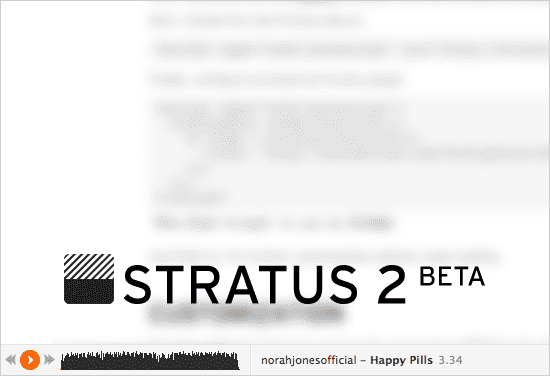
Stratus is a jQuery powered SoundCloud player that lives at the bottom (or top) of your website or blog. In version 2, we’ve rebuilt Stratus from the ground up to include many requested features, a nicer aesthetic, and a much easier installation.
Pumped? Yeh, me too. Here’s how to participate in the BETA:
Moving API Support to Stack Overflow
March 7th, 2012 by Paul OsmanThe SoundCloud Developer Community has grown immensely. We have over ten thousand registered applications and over three hundred showcased in our App Gallery. Our goal as the Platform Team is to provide the best API tools possible, while also providing support and inspiration. So far, our primary channels have been this blog, our Twitter account, and our mailing list, hosted on Google Groups.
In the coming months, you can expect some changes as we retool to accommodate the growth of our developer community. We are revisiting everything and doubling down on our efforts to provide the best, most accessible platform possible for building amazing applications that use sound in exciting new ways on the web.
Announcing new Python SDK
March 6th, 2012 by Paul OsmanIt’s no secret that SoundCloud is a Ruby shop, but that doesn’t stop us from giving some love to the Pythonistas in our community.
Our old Python API wrapper has been neglected. It doesn’t support OAuth 2 or all of the resources made available by our API. It’s old and crufty and we’re sorry for letting it get that way. In order to make it up to you, we wrote a new one and made it much better.
How we do… Retrospectives
March 4th, 2012 by Alexander GrosseSoundCloud started its agile journey with Scrum and eventually moved to an approach based on Kanban (more on that in one of the next blog posts). Regardless of the methodology we follow, though, we strongly believe that the most important tools an agile team can use to practice continuous improvement are retrospectives. You might ask why we consider the retrospective to be the most important one? We think it is key to constantly learn and to improve based on our experiences. The best way to…
SoundCloud at Music Hack Day SF
February 14th, 2012 by paulosmanThis past weekend, hundreds of hackers showed up at the TokBox HQ with a mission to build the future of music. The event started with pitches — giving sponsors a chance to show off their APIs — followed by in-depth workshops where attendees could learn more about each platform and ask questions related to their project. Once the hacking time started, people quickly broke off into groups and got to work.